
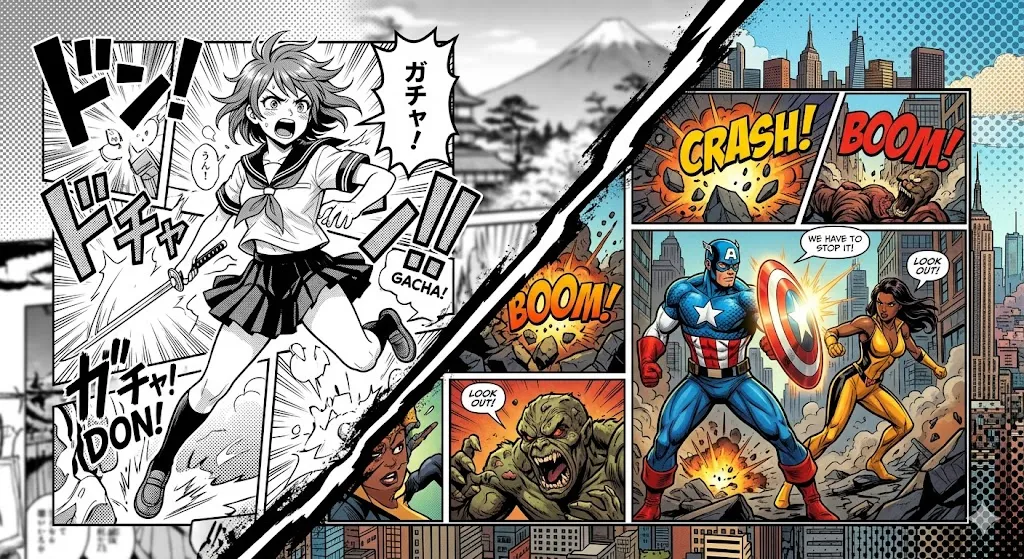
Two art forms, both built from panels and ink — yet picking up a manga volume and a Marvel trade paperback feels like visiting two entirely different planets. That difference isn’t accidental. It runs all the way down to philosophy, history, culture, and craft. We explain everything that separates manga from Western comics — and why that gap makes both more fascinating.
1. Reading Direction: Right to Left vs. Left to Right
The most immediately obvious difference is the direction you read. Japanese manga reads from right to left, top to bottom — mirroring the direction of traditional Japanese script. When you open a manga volume, you start at what a Western reader would consider the “back” of the book. Western comics, following the conventions of English text, read left to right.
This isn’t just a formatting quirk. It shapes everything: how panels are composed, how action flows across a page, how the eye is guided through a fight scene. A manga artist designs every spread knowing the reader’s gaze enters from the upper right. A DC or Marvel artist composes for the opposite entry point. The entire visual grammar of pacing and tension is built around that initial assumption.
Early Western editions of manga used to “flip” the artwork — mirroring the pages horizontally so they read left to right. Publishers largely abandoned this practice because fans objected; flipping warped character designs, reversed text on signs, and broke the visual logic of action sequences. Today, most manga is published in its original right-to-left format, inviting Western readers to meet the work on its own terms.
2. Black and White vs. Full Color
Walk into any comic book store and you’ll notice it instantly: Western single-issue comics are almost always printed in full color, while manga volumes are almost entirely black and white (with the occasional color chapter at the beginning of a collected volume).
This isn’t simply a cost-cutting measure — though economics did play a role historically. Manga artists have developed an extraordinarily sophisticated visual language within the constraints of black, white, and gray. Through screen tones (sheets of pre-printed dot patterns layered onto artwork), hatching, cross-hatching, and contrast manipulation, manga-ka (manga artists) convey texture, depth, light, shadow, weather, and mood with zero color information.
There’s a particular emotional intensity that comes from this restriction. Without color to signal mood, the reader’s imagination fills the gap. Readers of Berserk, Vagabond, or Monster often describe a cinematic quality to the art — because their brains are doing part of the color-grading work subconsciously.
Western comics use color as an integral storytelling tool. Colorists are credited artists whose work can transform the emotional register of a scene. The flat, bold primaries of Golden Age superhero comics telegraph optimism and clarity. The desaturated, gritty palettes of modern “prestige” comics signal moral ambiguity. Color is a voice in Western sequential art — one that manga deliberately sets aside.
3. Publication Format and Release Schedules
In Japan, manga is primarily published in thick weekly or monthly anthology magazines — publications like Weekly Shōnen Jump, Weekly Shōnen Magazine, or Bessatsu Margaret. Each issue contains chapters from dozens of ongoing series. Popular chapters from these magazines are later collected into tankōbon volumes, the standardized paperback format most Western readers encounter.
American and British comics have traditionally been built around the monthly single issue: a 22–32 page periodical collecting one chapter of an ongoing story. These are then gathered into trade paperbacks. The periodical market has been shrinking for decades, but the single-issue format still defines the industry’s rhythm and economics.
The consequences for storytelling are significant. A manga chapter in a weekly anthology might be only 15–20 pages — forcing extreme compression and the perfection of the cliffhanger. An American single issue is longer but still bound by the 30-page ceiling. Both formats push their creators toward episodic structure, but the sheer volume of manga output — a weekly chapter from a serialized series for years on end — demands a different relationship to creative endurance.
Many celebrated manga run for hundreds of chapters over a decade or more: One Piece has exceeded 1,100 chapters. Golgo 13 has been running since 1968. This creates a storytelling scale that most Western superhero comics approach through shared universes and decades of rotating writers — a fundamentally different solution to the same problem of longevity.
4. Authorship: Single Creator vs. Creative Teams
Perhaps the most structurally important difference: manga is almost always created by a single author, or sometimes a small duo. Akira Toriyama wrote and drew Dragon Ball. Naoki Urasawa wrote and drew Monster, 20th Century Boys, and Pluto. Hajime Isayama wrote and drew every chapter of Attack on Titan. The manga-ka is, in most cases, the singular creative intelligence behind the work.
Western superhero comics are built on an industrial model. A writer scripts the story, a penciler draws the layouts, an inker finalizes the line art, a colorist adds color, a letterer places the text, and an editor oversees everything. Characters like Superman, Batman, or Spider-Man have been written and drawn by hundreds of different creative teams over decades. They are corporate intellectual properties that exist independently of any one creator.
This creates two very different emotional relationships with the work. Reading a long manga series is like reading an author’s complete works — you come to understand a singular creative voice, its obsessions, its blindspots, its growth. Reading decades of a Western superhero title is more like watching a repertory theater company — the character is the constant, while the interpretations shift.
Neither model is superior, but they produce profoundly different reading experiences. A manga series ends when its creator decides the story is complete. A Batman comic never ends — it’s a franchise. The question of “what does this story mean?” has a different kind of answer depending on which tradition you’re reading.
5. Genre Diversity and the Demographics System
Ask a casual observer what Western comics are about and they’ll likely say: superheroes. That’s not entirely fair — the medium encompasses crime comics, horror, literary fiction, memoir, and more — but the superhero genre dominates English-language comics so thoroughly that many people consider it synonymous with the form itself.
Manga is organized along explicit demographic lines, and its genre diversity is staggering. The major categories are:
- Shōnen — targeted at young male readers; action, friendship, self-improvement (Naruto, My Hero Academia)
- Shōjo — targeted at young female readers; romance, emotion, relationships (Sailor Moon, Fruits Basket)
- Seinen — targeted at adult men; wider tonal range, often darker or more complex (Berserk, Vagabond, Dungeon Meshi)
- Josei — targeted at adult women; mature romance and slice of life (Nana, Chihayafuru)
- Kodomomuke — for young children (Doraemon, Pokémon Adventures)
Beyond demographics, manga covers virtually every conceivable subject: competitive cooking (Food Wars!), mahjong (Akagi), chess (81diver), figure skating, flower arranging, golf, bread baking, classical music, farming, nursing, legal drama — the list is genuinely endless. This diversity exists because manga is simply how Japan tells stories visually, across every genre and audience. It’s the equivalent of novels in Japanese cultural life.
Western comics have been slowly diversifying — the growth of graphic novels, webcomics, and publisher lines targeting non-superhero audiences has expanded the landscape considerably — but the genre monoculture remains a defining feature of the mainstream industry.
6. Visual Language and Panel Composition
Manga and Western comics have developed distinct visual vocabularies for depicting the same things: motion, emotion, time, impact.
Speed Lines and Motion
Manga uses speed lines (also called motion lines or action lines) extensively and expressively. Lines radiating from a focal point convey explosive force. Parallel lines across the background convey rapid movement. These conventions have been refined over decades into a precise grammar — readers unconsciously decode them the instant their eyes pass over them. Western comics use motion blur and speed lines too, but typically with more restraint and less stylization.
Emotional Chibi and Exaggeration
Manga frequently employs sudden shifts into a super-deformed or “chibi” style — characters briefly rendered in a cartoonishly simplified, adorable form — to signal comedy, embarrassment, or exaggerated emotion. This stylistic code-switching doesn’t exist in Western comics. American artists typically maintain a consistent level of stylization throughout a work, even in comedic moments.
Sweat Drops, Blushes, and Visual Symbols
Manga has an extensive vocabulary of symbolic visual shorthand: a giant bead of sweat on the forehead signals nervous exasperation; speed lines through a character’s face convey shock; a vein-pop symbol on the forehead signals suppressed anger; rosy cheeks indicate attraction or embarrassment. These are semiotic conventions that readers of manga internalize automatically. Western readers encountering them for the first time may need a moment to decode them — or may simply pick them up intuitively from context.
Panel Size and Page Layout
Western comics tend toward regular grid-based panel layouts, though splash pages and varied compositions exist. Manga is far more experimental with panel shapes, sizes, and arrangements — panels overlap, bleed into each other, abandon borders entirely, or shrink to thumbnails beside a massive full-page image. This flexibility is partly a product of black-and-white printing: without color to manage across a complex layout, the artist has more compositional freedom.
7. The Treatment of Time and Silence
One of the most striking differences for readers moving between the two traditions is the treatment of time within a panel sequence.
Western comics have generally moved toward maximizing narrative efficiency: each panel should advance the plot, reveal character, or do both. Scott McCloud’s influential book Understanding Comics (1993) formalized much of this theory, including the idea that the “gutter” — the space between panels — is where the reader’s imagination does the work of transition.
Manga frequently uses panels to do something Western comics rarely attempt: simply exist in a moment. A character stands at a window. Rain falls on a street. A meal sits on a table. These “silent” panels don’t advance the plot; they establish mood, allow emotional beats to breathe, and invite the reader to inhabit a scene rather than race through it. Certain manga — particularly slice-of-life works or the quieter moments inside action series — use this technique with great sophistication.
Manga-ka like Inio Asano (Goodnight Punpun) or Hitoshi Ashinano (Yokohama Kaidashi Kikou) have built entire storytelling philosophies around these silences. The result is a temporal quality that feels genuinely different from Western comics — more like the pacing of literary fiction or certain kinds of cinema than the propulsive, panel-efficient rhythm of a superhero comic.
8. Facial Expression and the “Big Eyes” Tradition
The large, expressive eyes that characterize so much manga art are not arbitrary stylization. They trace back to the influence of early postwar manga pioneer Osamu Tezuka — himself deeply influenced by Disney animation, particularly the large-eyed characters of early Fleischer and Disney studios. Tezuka adapted this expressive eye design into manga, and it became a foundational convention of the medium.
Big eyes serve a specific function: they are the primary vehicle for emotional expression. In a medium where faces carry most of the storytelling weight (and where detailed full-body anatomy is sometimes sacrificed for speed under weekly deadlines), the eyes must communicate a vast range of inner states. Sadness, joy, rage, longing, confusion, determination — all of it registers primarily through the eyes, which are therefore drawn large enough to make every shift legible.
Western comics, rooted in different artistic traditions — particularly American illustration and European ligne claire — tend toward more anatomically realistic facial proportions, with expression distributed more evenly across the whole face. The result is a different emotional register: more naturalistic, perhaps, but often less immediately intense.
9. The Role of the Body and Fan Service
Both traditions sexualize bodies — this is not a distinction unique to one side — but the conventions differ. Western superhero comics have long been criticized for idealized, hypermuscular male bodies and hypersexualized female bodies drawn in anatomically impossible poses. These conventions are rooted in the power fantasies of mid-20th-century American culture and the demographics of their original audience.
Manga has its own complicated relationship with the body, including the extensive “fan service” tradition — gratuitous sexualized imagery inserted into shōnen series, the existence of explicit adult manga (hentai), and criticisms about the depiction of female characters in many mainstream series. At the same time, shōjo and josei manga have developed traditions of depicting male bodies for female readership with their own conventions — and the range of body types represented across the full scope of manga is considerably broader than what mainstream Western superhero comics typically offer.
These are genuinely contested areas within both fan communities and academic criticism of both forms. What’s clear is that the cultural context shaping how bodies are drawn and what they are made to mean is different — and those differences are visible in the art.
10. Endings: Complete Stories vs. Infinite Franchises
This may be the most profound structural difference. Manga ends. Most manga series — especially creator-driven ones — have planned endings, and when the story is complete, the series concludes. Fullmetal Alchemist ended after 108 chapters. Attack on Titan ended after 139 chapters. Death Note ended after 108 chapters. The story was told, and then it stopped.
American superhero comics, by contrast, essentially never end. Superman has been continuously published since 1938. Batman since 1939. Spider-Man since 1963. These characters cannot die (or if they die, they return), cannot age meaningfully, cannot have their central conflicts resolved, because resolution would end the franchise. The status quo must be preserved, reset, or rebooted so the next creative team can start again.
This creates a fundamental difference in what kind of story can be told. Manga can have genuine tragedy, genuine loss, genuine character transformation, because the author is moving toward a destination. A character can die and stay dead; a relationship can resolve into marriage or heartbreak with finality; the world can be saved or destroyed. Western superhero comics must treat all such events as temporary, which means readers understand — consciously or not — that the stakes are permanently artificial.
This isn’t a flaw of Western comics so much as an economic and structural reality. Franchises are valuable. Characters who have been building cultural equity for eighty years are not going to be allowed to conclude. But it does explain why readers who want the emotional satisfaction of a complete narrative arc often find it more readily in manga.
11. Cultural Context and the Stories Each Tradition Tells
Manga doesn’t exist outside Japanese culture — it is saturated with it. The social structures of schools and workplaces, the importance of group belonging, the tension between individual desire and social obligation, Shinto and Buddhist ideas about nature and spirits, concepts like gaman (patient endurance), mono no aware (the bittersweet beauty of impermanence), amae (dependency and indulgence) — these ideas and values are woven into the fabric of manga storytelling without always being named or explained.
This is part of why reading manga can feel like encountering a genuinely different way of organizing experience. The emotional priorities are different. What counts as a satisfying resolution is different. The relationship between the individual and the group, between effort and destiny, between the living and the dead, between the human and the natural world — all of these are approached from starting points that Western storytelling traditions don’t share.
Western comics are similarly embedded in their cultures — the American mythology of individual heroism, the Protestant work ethic embedded in superhero origin stories, the Cold War anxieties that shaped the X-Men — but these feel invisible to Western readers because they are simply the water those readers swim in.
When you read manga, you notice the water. And that noticing is part of what makes the experience feel so distinctively different.
12. The Anime Pipeline and Cross-Media Identity
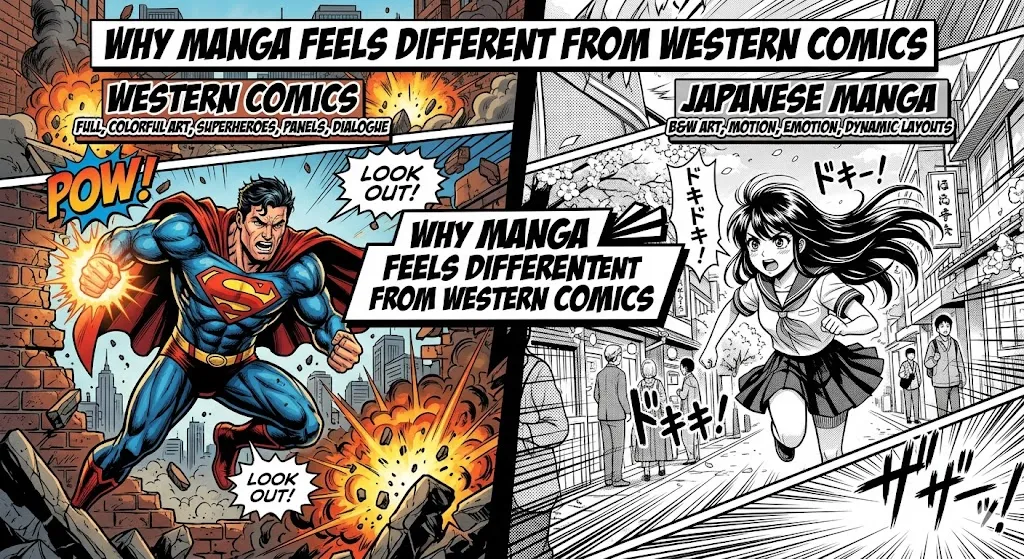
Most popular manga are eventually adapted into anime (Japanese animated series or films). This pipeline is so well-established that many readers approach manga specifically as the “source material” for an anime they love — reading to get ahead of the adaptation, or to experience a story in its original form.
This relationship between manga and anime has shaped the aesthetics of both. Character designs in manga are often developed with eventual animation in mind — or conversely, manga adaptations of anime properties carry the visual imprint of animation design. Voice actors become inseparable from characters in the minds of Japanese audiences, adding an audio dimension to the reading experience for those who’ve watched the anime first.
Western comics have spawned their own adaptations — films, TV series, animated shows — but the relationship is different. Marvel and DC comics exist primarily as IP development pipelines for billion-dollar film franchises that have, in many ways, outgrown and eclipsed the source material in cultural prominence. The Marvel Cinematic Universe is vastly more influential than any individual comic series. The adaptation has consumed the original.
In Japan, manga retains a cultural primacy that Western comics have increasingly ceded to film. The serialized chapter, published weekly and read on a train or a phone, remains the beating heart of the medium — not a scouting report for a future film.
13. Digital Manga and the Webtoon Revolution
The rise of digital publishing has added a new wrinkle to this comparison. Webtoons — vertical-scrolling digital comics originating primarily from South Korea but now global in reach — are formally distinct from traditional manga (they’re technically manhwa), but they’ve blurred the boundaries of what “manga-style” digital comics look like. Many webtoons use color and manga-influenced aesthetics while being formatted for smartphone screens rather than printed pages.
Digital manga publishing in Japan has exploded, with platforms like Shōnen Jump+ publishing manga that exists exclusively online. These digital-native manga sometimes experiment with formats impossible in print. Western comics have been slower to adapt to digital formats, though publishers like ComiXology (now absorbed into Amazon) made significant inroads.
The broader point: the formal differences between manga and Western comics are increasingly in dialogue with each other as global readership grows and digital distribution makes both more universally accessible. A generation of cartoonists raised on both traditions is producing work that consciously synthesizes their visual languages — which may mean the next decade of comics history is one of productive convergence rather than clean separation.
Conclusion: Two Windows on the Same Human Experience
Manga feels different from Western comics because it is different — in its history, its economics, its artistic conventions, its cultural assumptions, and its relationship to narrative time. These differences aren’t deficiencies on either side. They’re the result of two parallel traditions developing their own sophisticated answers to the fundamental challenge of sequential visual storytelling.
What makes both traditions worth reading is precisely that they aren’t the same. Manga can take you somewhere Western comics cannot — into a different relationship with silence, with endings, with collective culture, with the expressive possibilities of a line on paper. And Western comics offer things manga doesn’t: the richness of color used as a storytelling instrument, the conversation between decades of different creative voices interpreting the same iconic characters, the particular American mythology that superhero stories embody and interrogate.
The readers who know both traditions are the lucky ones. They have twice as many tools for understanding what sequential art can do — and twice as much wonder available on any given page.
Related reading: Understanding Comics by Scott McCloud · Manga! Manga! The World of Japanese Comics by Frederik Schodt · The Anime Machine by Thomas Lamarre · Super Graphic: A Visual Guide to the Comic Book Universe by Tim Leong
Frequently Asked Questions
What is the biggest difference between manga and Western comics?
The most fundamental difference is authorship. Manga is almost always created by a single artist who writes and draws the entire series, giving it one consistent creative voice. Western comics — especially superhero titles — are produced by rotating teams of writers, pencilers, inkers, and colorists. This shapes everything: how stories are paced, whether they have real endings, and how deeply a creator’s personal vision comes through.
Why is manga in black and white?
Manga is serialized weekly or monthly in thick anthology magazines, and black-and-white printing keeps production costs and turnaround times manageable. Over time, artists developed such a refined visual language using contrast, hatching, and screen tones that color became unnecessary — and many readers feel the monochrome style actually adds emotional intensity.
Is manga harder to read than Western comics?
The right-to-left reading direction takes most new readers only a chapter or two to adjust to. Beyond that, manga uses visual shorthand — speed lines, sweat drops, chibi expressions — that feels unfamiliar at first but becomes second nature quickly. Most people find it no harder than adjusting to any new storytelling convention.
Do manga stories actually have endings?
Yes — and this is one of the things readers love most about manga. Because a single creator controls the story, they can plan and execute a real conclusion. Series like Fullmetal Alchemist, Death Note, and Attack on Titan all ended intentionally. Western superhero comics, by contrast, are ongoing franchises that rarely conclude because the characters are too commercially valuable to retire.
Are Western comics only about superheroes?
No, though superheroes dominate the mainstream market. There’s a rich tradition of Western graphic novels covering memoir, crime, horror, literary fiction, and more — works like Maus, Persepolis, and From Hell are widely acclaimed. That said, manga covers a far broader range of everyday genres — cooking, sports, romance, farming, music — because it fills the role that novels play in Japanese popular culture.
Can you enjoy manga without watching anime first?
Absolutely. Manga stands completely on its own — anime adaptations come later, if at all. Many fans prefer reading manga to watching anime because it’s the original, unaltered version of the story, often richer in detail and always finished before the adaptation catches up.
Which should a beginner start with — manga or Western comics?
It depends entirely on what kind of story you want. If you want a complete, self-contained narrative with a beginning and end, manga is usually the easier entry point — pick up a finished series and read it like a novel. If you love shared universes, iconic characters with decades of history, and full-color art, Western comics offer that. Many readers end up enjoying both once they’ve spent time with each.
Leave a Reply