
Google search is changing, and website owners are facing a new challenge: getting their content noticed not only in traditional search results but also in AI-generated answers. Google’s AI Overviews summarize information from multiple online sources and display links to selected websites that support the answer.
For bloggers, publishers, and small website owners, this creates a new opportunity. A website does not necessarily need millions of visitors, a famous brand name, or years of established authority to earn an AI Overview citation. What matters is whether its content provides relevant, reliable, clearly presented information that helps answer a specific search query.
Understanding how AI Overviews discover and select sources can help smaller websites compete for visibility, attract new readers, and build authority in their niche.
Key Takeaways
- Small websites can get cited: A blog does not need to rank first in Google Search to appear as a source in AI Overviews.
- Relevance matters: Content should directly answer specific search questions and match user intent.
- Originality creates opportunities: Unique insights, practical examples, and original research help differentiate articles from competing content.
- Build topical authority: Publishing interconnected articles around a focused subject helps establish expertise.
- Prioritize content quality: Accurate, well-researched, reliable, and clearly structured information is essential.
- Use SEO fundamentals: Internal linking, appropriate schema markup, descriptive headings, and technical accessibility support search visibility.
- AI content needs human oversight: AI-assisted articles should be fact-checked, improved, and enriched with genuine value.
- Monitor performance: Google Search Console and Google Analytics help identify opportunities to improve organic and AI search visibility.
What Are Google AI Overviews?
Google AI Overviews are AI-generated summaries that appear within Google Search for selected queries. Instead of displaying only a traditional list of websites, Google provides a summarized answer and includes links to pages that support or expand on the information.
These summaries can combine information from several websites, allowing users to understand a topic without opening multiple search results.
For website owners, the important distinction is that appearing in an AI Overview is not exactly the same as ranking first in traditional organic search results. Google can retrieve and cite relevant pages that do not occupy the highest positions for the original search query.
Google also uses a technique called query fan-out. This means that a complex question can lead to several related searches covering different aspects of the topic. The system can then identify additional supporting pages and present a broader selection of useful sources.
This creates opportunities for smaller publishers with focused, informative content. A website might not rank among the top results for a broad keyword but could still provide an answer that is particularly useful for a related question.
How AI Overviews Decide Which Blogs to Cite
Google does not publish a complete formula for selecting AI Overview citations. However, its official documentation explains that AI search features rely on existing search systems, relevant web content, and helpful, reliable information.
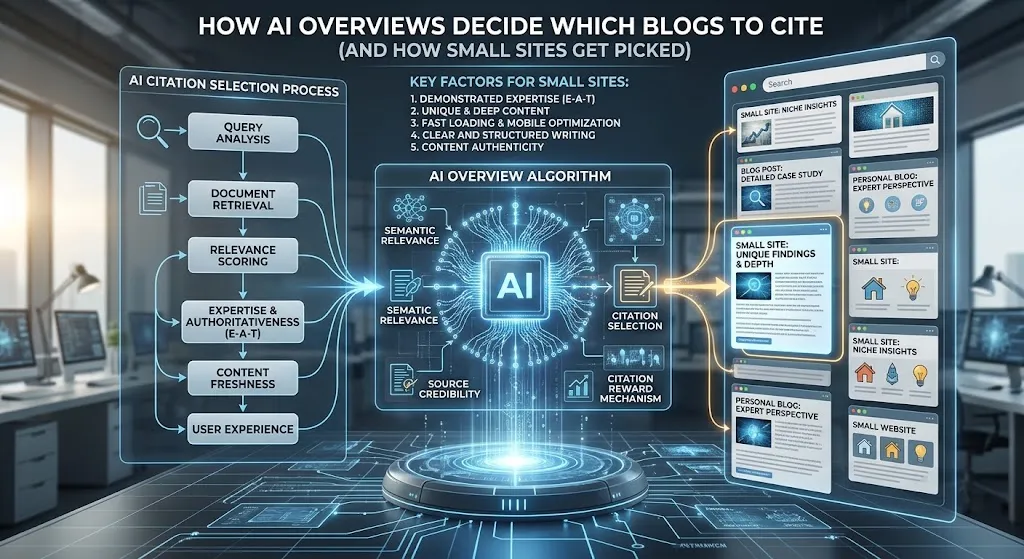
Several practical factors can influence whether a blog post becomes a supporting source.
1. Content Must Directly Answer the Search Query
Relevance is one of the most important considerations.
When someone searches for a specific question, AI systems need pages that provide clear information about that subject. Articles that discuss a topic generally without answering the actual question may be less useful than focused pages containing specific explanations.
For example, consider the query:
How can small businesses reduce operating costs?
A general article about entrepreneurship might mention expenses briefly. However, a focused article explaining practical ways to reduce rent, software subscriptions, energy consumption, and administrative costs offers more directly relevant information.
Small websites should therefore build articles around real search questions rather than relying exclusively on broad keywords.
A useful approach is to include the main question in the heading and provide a direct answer immediately below it.
2. Clear Structure Makes Information Easier to Understand
AI systems need to identify relevant information within a page. A well-organized article makes this process easier.
Instead of publishing long blocks of uninterrupted text, divide content into logical sections with descriptive headings.
A useful article structure includes:
- An introduction explaining the topic.
- A direct answer to the main question.
- H2 headings covering the major subtopics.
- H3 headings for specific explanations.
- Short paragraphs containing useful information.
- Lists for steps, comparisons, or recommendations.
- An FAQ section addressing related questions.
For example, an article about starting an online business could include sections on initial costs, business registration, choosing a platform, marketing, and common mistakes.
Each section should communicate a complete idea rather than simply repeat the main keyword.
Good formatting does not guarantee an AI citation, but it helps make useful information accessible to both readers and search systems.
3. Original Information Gives Small Websites an Advantage
One of the biggest mistakes publishers make is rewriting articles that already exist across hundreds of websites.
AI-generated search experiences have access to enormous amounts of similar information. Publishing another generic article with the same advice provides little additional value.
Smaller websites can improve their chances by offering something distinctive.
This might include:
- Original examples and practical scenarios.
- Comparisons based on specific situations.
- Expert explanations of complicated subjects.
- Firsthand observations and experiences.
- Original research or survey findings.
- Useful checklists and step-by-step instructions.
For example, instead of publishing another article titled “How to Save Money,” a small finance blog could explain how freelancers can manage irregular monthly income.
The narrower subject provides a more specific reason for readers and search systems to find the article useful.
Originality does not necessarily require expensive research or professional surveys. Even a well-developed explanation with practical examples can provide more value than a superficial overview.
4. Topical Authority Matters More Than Publishing Random Articles
A small website does not need to cover every subject to become a useful source.
Building topical authority means consistently publishing relevant content around a particular subject or group of related topics.
For example, a website focusing on personal finance could develop a collection of articles covering:
- Budgeting for beginners.
- Building an emergency fund.
- Managing credit card debt.
- Saving money on everyday expenses.
- Financial planning for freelancers.
- Common budgeting mistakes.
These articles should be connected through relevant internal links.
This helps readers discover related information and gives search engines a clearer understanding of the website’s subject coverage.
A smaller website with 25 useful, interconnected articles about personal finance may offer a stronger topical focus than a website with 200 unrelated posts covering travel, technology, health, entertainment, and business.
The goal is not simply to publish more content. It is to develop a recognizable area of expertise.
5. Credibility and Reliable Sources Matter
AI-generated answers need information that can be supported by reliable sources.
For this reason, bloggers should pay attention to the accuracy and credibility of their content.

When an article discusses statistics, research findings, legal requirements, medical information, or financial matters, it should reference trustworthy sources.
Useful sources may include:
- Government websites.
- Academic institutions.
- Official industry organizations.
- Recognized research publications.
- Established professional organizations.
- Original studies and reports.
Website owners should also provide clear author information, an About page, and appropriate editorial details.
Where professional expertise is relevant, explain the author’s qualifications or identify the expert who reviewed the content.
A credible article should make it possible for readers to understand where important information comes from and why they should trust it.
6. Freshness and Accuracy Can Influence Source Selection
Some topics require regularly updated information.
For example, articles about technology, travel regulations, financial products, software, and industry developments can become outdated quickly.
Updating an article should involve more than changing its publication date.
Review the information, replace outdated statistics, verify external references, correct inaccurate statements, and add developments that genuinely improve the article.
However, not every topic requires frequent updates. An informative article explaining basic financial principles or historical events may remain useful for years.
The objective is to keep information accurate and relevant, not to make every article appear newly published.
Can Small Websites Get Cited Without Ranking on Google’s First Page?
Yes. Ranking highly in traditional Google search results can help, but it is not an absolute requirement for appearing in an AI Overview.
Research into AI Overview citations has found that a substantial share of cited pages do not rank in the top 10 for the corresponding search query.
This distinction is important because AI-generated answers can draw information from related searches, not just the exact keyword entered by the user.
Imagine a small website that publishes an article about affordable destinations for solo travelers.
The article might not rank highly for the broad keyword “best travel destinations.” However, it could contain particularly useful information about affordable European cities, transportation costs, safety considerations, and accommodation options.
When Google explores related questions about budget-friendly solo travel, that article may become a relevant supporting source.
This is why smaller publishers should not focus exclusively on competing for the most competitive keywords.
Specific questions, long-tail searches, and narrower informational topics can provide valuable opportunities.
How Small Websites Can Improve Their Chances of Being Cited
Getting an AI Overview citation cannot be guaranteed through a particular SEO technique. Nevertheless, publishers can take practical steps to make their content more useful, accessible, and relevant.
1. Target Specific Long-Tail Keywords
Broad keywords are often highly competitive and may be dominated by established publishers.
Instead of targeting only general phrases, identify specific questions that your intended audience searches for.
For example:
| Broad keyword | More specific search query |
|---|---|
| Personal finance | How to budget with an irregular income |
| Travel tips | How to travel around Italy without renting a car |
| Small business | How to reduce operating costs in a small business |
| Technology | How to protect personal information when using public Wi-Fi |
| Home improvement | How to reduce electricity consumption in an apartment |
Specific queries make it easier to create focused articles that address a clearly defined need.
2. Answer Important Questions Near the Beginning
Readers should not have to scroll through several paragraphs to find the answer.
Start with a concise explanation of the main topic, then expand on it throughout the article.
For example:
Question: How can freelancers manage irregular income?
Freelancers can manage irregular income by calculating their average monthly earnings, separating business and personal expenses, building an emergency fund, and setting aside money for taxes. A consistent budgeting system helps them prepare for months when payments are lower than expected.
The remaining article can explain each recommendation in greater detail.
This approach creates useful, self-contained sections that communicate information clearly.
3. Create Supporting Articles Around One Main Topic
Rather than publishing unrelated articles, develop content clusters.
Choose one central subject and publish several supporting articles that explore different aspects of it.

For example, a website covering travel could create a main article about visiting Portugal, supported by separate articles about the best cities, transportation, accommodation, local food, and travel costs.
Link these pages naturally so readers can move between related topics.
This strategy helps establish a recognizable subject focus while providing more comprehensive coverage.
4. Use Schema Markup Correctly
Structured data helps search engines understand the content and elements of a webpage.
Depending on the page, relevant schema types may include:
- Article.
- BlogPosting.
- Organization.
- Person.
- BreadcrumbList.
For example, Article or BlogPosting markup can describe the headline, author, publication date, and other information about a blog post.
However, website owners should understand that schema markup does not guarantee an AI Overview citation.
Google explicitly states that there is no special AI Overview schema or additional structured-data requirement for appearing in its AI search features. Structured data should accurately reflect the visible content of the page and follow Google’s documentation.
5. Strengthen Internal Linking
Internal links help visitors and search engines discover related pages.
Every important article should have relevant links to other useful content on the same website.
For example, an article about saving money could link to supporting articles about budgeting, emergency funds, debt management, and financial planning.
Use descriptive anchor text that explains what readers will find after clicking.
Avoid adding internal links simply to increase their number. Each link should provide a useful next step.
6. Make Sure Google Can Access and Index Your Content
Even an excellent article cannot become an AI Overview supporting link if Google cannot access it or if the page is not eligible to appear in regular Google Search results.
Small website owners should regularly check:
- Whether important pages are indexed.
- Whether robots.txt blocks crawling.
- Whether pages have accidental noindex directives.
- Whether canonical tags point to the correct URLs.
- Whether the XML sitemap includes important articles.
- Whether internal links lead to accessible pages.
- Whether important information is available as readable text.
Google Search Console is particularly useful for identifying indexing problems and monitoring organic search performance.
Technical accessibility should come before advanced AI SEO strategies.
Does AI-Generated Content Have a Chance of Being Cited?
Yes. Content created with AI assistance can appear in AI Overviews, provided it meets Google’s quality expectations and is useful to readers.
Google does not prohibit content simply because AI tools were used during production.

However, publishing large quantities of generic, repetitive, or unoriginal articles can create quality problems.
A better approach is to use AI as an editorial assistant rather than as a replacement for research and human judgment.
For example, AI can help with:
- Developing article outlines.
- Identifying related search questions.
- Improving readability.
- Organizing complex information.
- Creating initial drafts.
- Identifying missing sections.
The publisher should still verify factual claims, add original insights, check references, and ensure that the final article offers genuine value.
The important distinction is not whether AI was involved in writing. It is whether the finished content is accurate, useful, original, and trustworthy.
How to Track Whether Your Website Appears in AI Overviews
Measuring AI visibility requires more than checking traditional keyword positions.
Website owners should use several sources of information to understand how their content performs.
Google Search Console
Search Console provides information about impressions, clicks, average positions, and search queries. Google currently includes traffic from AI features within the overall Web search performance reporting rather than providing a separate, comprehensive AI Overview traffic report.
Google Analytics
Analytics can help identify visitors arriving from Google and other search-related sources, as well as the pages they visit and the actions they take.
Manual AI Overview checks
Search for important questions related to your website’s subject and examine whether Google displays an AI Overview and which websites it cites.
Because AI answers and citations can change, check several related queries over time rather than drawing conclusions from a single search.
Content performance reviews
Identify pages that receive impressions but few clicks, pages that are indexed but receive little visibility, and articles that attract traffic for unexpected long-tail queries.
These findings can help identify subjects that deserve additional content or improvement.
Common Mistakes That Prevent Small Blogs From Gaining AI Visibility
Some website owners focus so heavily on AI optimization that they overlook the fundamentals of publishing useful content.
Avoid these common mistakes:
- Publishing articles that repeat information already available everywhere.
- Targeting keywords without understanding the search intent.
- Creating dozens of unrelated articles without a clear subject focus.
- Using unsupported statistics and questionable references.
- Adding excessive keywords to headings and paragraphs.
- Publishing AI-generated articles without fact-checking.
- Neglecting internal links and technical indexing problems.
- Updating publication dates without improving the content.
- Using FAQ sections that repeat information already covered in the article.
- Adding structured data that does not match the visible page content.
There is no secret formula that guarantees inclusion in AI-generated answers. Sustainable visibility comes from consistently publishing content that deserves to be discovered.
Final Thoughts: Why Small Websites Should Not Ignore AI Overviews
AI Overviews are changing how people discover information, but they do not eliminate the importance of traditional SEO.
For smaller websites, the opportunity lies in becoming genuinely useful within a clearly defined subject area.
A focused website with original explanations, well-researched articles, accurate information, and a logical internal linking structure can offer something valuable even when competing against much larger publishers.
Instead of trying to publish more articles than established websites, concentrate on answering questions they may overlook. Cover specific subjects thoroughly, make information easy to understand, maintain technical accessibility, and build credibility over time.
AI search visibility is not something that can be switched on with a plugin or achieved through a single optimization technique. It is the result of creating a website that provides information worth finding, reading, and referencing.
Sources
- Google Search Central – AI Features and Your Website
- Google Search Central – Creating Helpful, Reliable, People-First Content
- Google Search Central – Introduction to Structured Data
- Google Search Central – SEO Starter Guide
- Google Search Central – Search Console Performance Report
- Search Engine Journal – Research and Analysis of Google AI Overviews and Citation Patterns
Leave a Reply