
If you follow anime or manga, you have probably seen the phrase “based on the light novel” more than once. Sword Art Online, Re:Zero, KonoSuba, Overlord and many other popular series started on the page as light novels before they ever reached the screen. But what exactly is a light novel, and how is it different from the manga and web novels people often confuse it with?
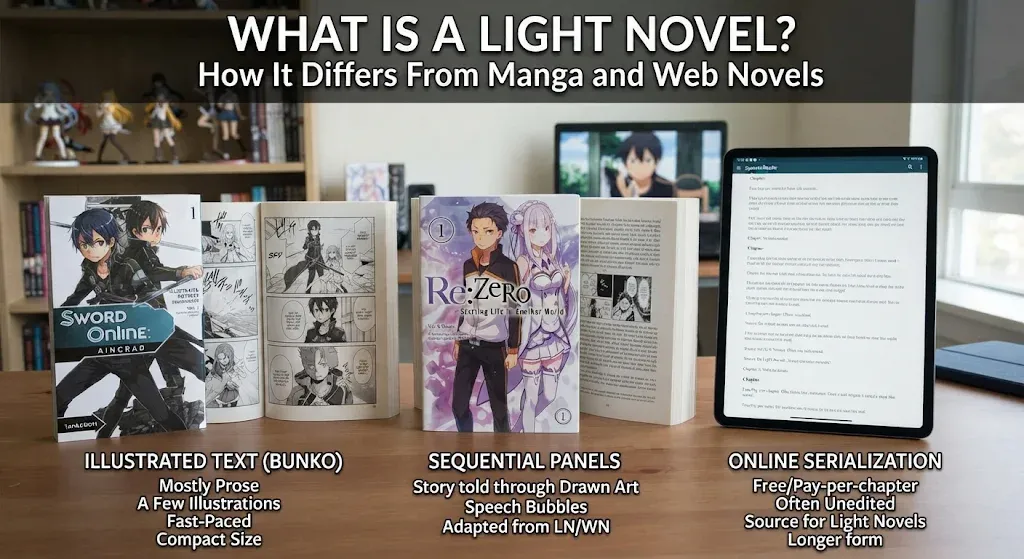
This guide explains it in plain terms.
What Is a Light Novel?
A light novel is a short, easy-to-read Japanese novel aimed mainly at teenagers and young adults. The name is a Japanese-English coinage (raito noberu, often shortened to “ranobe”), and the “light” refers to the reading experience: fast pacing, simple prose, lots of dialogue, and a story that moves quickly.
A few features define the format:
- Length: A typical volume is relatively short, often somewhere around 40,000 to 60,000 words, so one book can be read in a few hours.
- Illustrations: Volumes include a color cover, a few color plates, and black-and-white illustrations scattered through the text. These show characters, key scenes, and settings.
- Size and format: In Japan, light novels are usually printed in the compact bunko paperback size, which is small enough to carry on a commute.
- Style: Chapters are short, sentences are direct, and the tone leans toward entertainment. Many books are narrated in the first person.
- Serialization: Most stories run for multiple volumes, with a new book released every few months.
Light novels cover nearly every genre, including fantasy, romance, school life, science fiction, mystery, and comedy. They are best known for isekai (characters transported to another world), but the format is much broader than that.
Where Light Novels Come From
Light novels are published under dedicated imprints from Japanese publishers. Well-known examples include Dengeki Bunko, Fujimi Fantasia Bunko, and Sneaker Bunko. Many of these imprints run annual new-author contests, which is how a lot of writers break into the industry.
Because publishers constantly look for stories that can become anime, manga, and games, light novels often act as a starting point for a larger franchise. A successful volume can lead to a manga adaptation, an anime series, merchandise, and spin-offs.
Light Novel vs. Manga: What’s the Difference?
The biggest difference is simple: a manga is told through drawn panels, while a light novel is told mainly through text.
| Light Novel | Manga | |
|---|---|---|
| Main storytelling method | Prose with occasional illustrations | Sequential panels with art and speech bubbles |
| Who creates it | Usually a writer and an illustrator | Usually a mangaka, sometimes with a separate writer |
| Reading time per volume | Several hours | Often under an hour or two |
| Interior thoughts | Described in detail | Shown through short text or visuals |
| Release format | Bunko paperback volumes | Magazine chapters collected into tankobon volumes |
Because a light novel is mostly text, it can spend much more time inside a character’s head. Internal monologue, world-building details, and backstory that a manga would need to compress into a panel or two can be explored at length on the page.
A manga, on the other hand, communicates through composition, expression, and pacing. A single drawn expression can replace a paragraph of description.
Why Many Series Exist as Both
It is very common for a popular light novel to receive a manga adaptation. The manga retells the story in visual form, often condensing or rearranging events to fit the format. If you enjoyed the manga version, the light novel usually offers more detail and sometimes more of the story than the adaptation covers. If you want to understand how manga chapters are collected into books, see our guide to what a tankobon is.
Light Novel vs. Web Novel: What’s the Difference?
A web novel is a story published online, usually in installments, on a website or platform. A light novel is a physical or official digital book released by a publisher. The two overlap more than most people realize, but they are not the same thing.
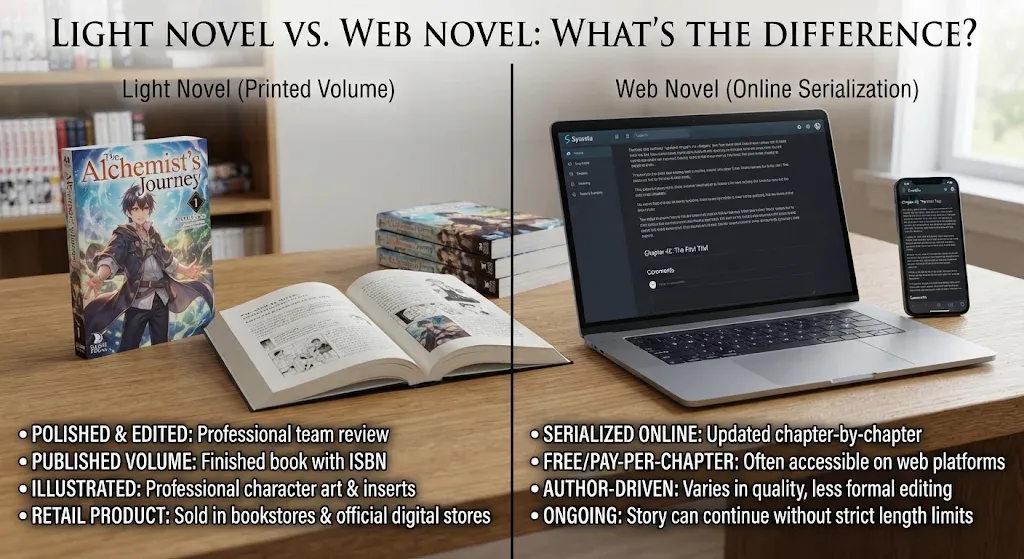
Web novels are typically:
- Posted for free or on a pay-per-chapter basis
- Updated frequently, sometimes daily or weekly
- Written without a professional editor, so quality and polish vary
- Often much longer, since there is no page limit
Light novels are typically:
- Edited and proofread by a publishing team
- Released in finished volumes
- Illustrated by a professional artist
- Sold through bookstores and official digital stores
How Web Novels Become Light Novels
In Japan, websites such as Shosetsuka ni Narou (often called Syosetu) and Kakuyomu let anyone post their stories. When a series attracts a large audience, a publisher may offer to turn it into a light novel. The story is usually revised, divided into volumes, and paired with an illustrator.
Several well-known series followed this path, including Sword Art Online, which began as an online work before being published in print, and That Time I Got Reincarnated as a Slime, which also started on the web.
This pipeline is one reason isekai and other web-friendly genres became so common. Online readers vote with their clicks, and popular ideas rise quickly.
What About Korean and Chinese Web Novels?
The web novel model is not limited to Japan. In Korea and China, serialized web novels are a major source of new stories. Many popular Korean webtoons, such as Solo Leveling, were adapted from web novels. This connects directly to the trend we covered in our article on why so many manhwa become Korean dramas: online stories with proven audiences are lower-risk to adapt.
In short, web novels are often the testing ground, light novels are the polished print version, and manga, manhwa, and anime are the adaptations.
How the Three Formats Compare
| Light Novel | Manga | Web Novel | |
|---|---|---|---|
| Format | Illustrated text book | Illustrated panels | Online text installments |
| Edited by a publisher | Yes | Yes | Usually no |
| Illustrations | A few per volume | Entire story | Rarely |
| Length | Short per volume, long as a series | Varies | Often very long |
| Cost | Paid | Paid | Often free |
Why Light Novels Matter to Anime and Manga Fans
If you enjoy anime, light novels are worth knowing about for a few reasons:
- They are a major source of anime. A large share of popular anime series each season are based on light novels.
- Anime often skips content. Because a show has limited episodes, it may cover only part of the story. The light novel can continue where the anime stops.
- You get more depth. Characters’ thoughts, background details, and side events are usually richer on the page.
- They are accessible. Short chapters and plain language make them approachable, including for people learning Japanese.
Popular Light Novel Series to Know
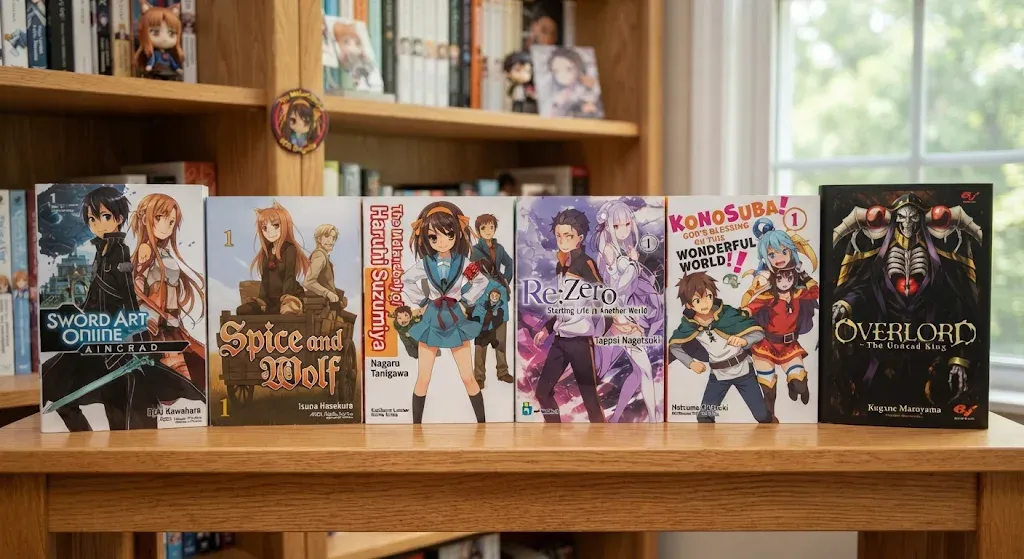
These series are well known and show the range of the format:
- Sword Art Online: Players trapped in a virtual reality game.
- Spice and Wolf: A traveling merchant and a wolf deity in a story built around economics and conversation.
- The Melancholy of Haruhi Suzumiya: A school comedy with science fiction twists.
- Re:Zero: Starting Life in Another World: A dark fantasy where the hero returns to life after death.
- KonoSuba: A parody-style fantasy comedy.
- Overlord: A player stuck in a game as a powerful skeleton ruler.
If you are new, start with a series you have already seen as an anime. You will recognize the characters and can focus on how the writing differs.
How to Start Reading Light Novels
- Pick a familiar series. An anime you liked is the easiest entry point.
- Buy official translations. Many light novels are licensed in English and available in print and digital editions. Official releases support the authors and illustrators. Our guide to legal manga and digital reading apps is a good place to start for safe platforms.
- Start with volume one. Most series are built to be read in order.
- Expect a different pace. If you are used to manga, give yourself time to settle into reading prose.
Frequently Asked Questions
Yes. They are novels, just shorter and more casual in style than many traditional literary books. Quality varies, as with any genre.
No. They are aimed at teens and young adults, but many series include mature themes and have large adult readerships.
Yes, but only a limited number. The text carries the story, and the illustrations support it.
No. A web novel is published online, often without professional editing. A light novel is an edited, illustrated book. Some light novels began as web novels.
Either works. Watching first helps you picture the characters, while reading first often gives you the fuller story.
Final Thoughts
A light novel is a short, illustrated, fast-paced novel that sits between traditional books and manga. It tells stories in text, often goes deeper than its manga and anime adaptations, and frequently grows out of the web novel scene. Once you understand how these formats connect, it becomes much easier to explore a favorite story across prose, panels, and screen.
If you want to explore related formats next, check our explainers on manhwa, manhua, and manga demographics.
Sources
- Japan Foundation – Japanese Book News
- Science Fiction Encyclopedia – Light Novel
- Kyoto Seika University – Academic Research on Light Novels
- KADOKAWA – Kakuyomu Official Platform
- KADOKAWA – Sword Art Online Publishing Announcement
- Kakao Entertainment – Solo Leveling
- KADOKAWA – Developing Novel Writing Talent
- VIZ Media – Haikasoru vs. Light Novels
Leave a Reply