Deep Dive · Updated 2026
Why Are Webtoons So Popular?
The Real Answer Is More Interesting Than You Think
Twelve specific reasons backed by data, psychology, cultural history, and the creator economy — not the surface-level list you’ve already read.
Ask most people why webtoons are popular and you get the same answer: they’re on your phone, they’re free, they’re easy to read. That’s true — but it explains almost nothing. Plenty of things are free, phone-friendly, and easy. Most of them don’t build 82 million monthly readers or generate $7.8 billion in annual market value.
The real reasons webtoons have become one of the fastest-growing entertainment formats in the world are more interesting, more specific, and more connected to deeper shifts in how people want to consume stories in the 2020s. This article goes after those real reasons — the psychology, the format design, the cultural context, the creator economics, and the storytelling innovations that no amount of “it’s free and mobile-friendly” summarizing actually explains.
The webtoon market was valued at $7.8 billion in 2025 and is projected to reach anywhere from $28 billion to $36 billion by the early 2030s, growing at a CAGR of between 15% and 30% depending on the research source. Romance remains the most dominant genre, holding approximately 39.4% of the global market share in 2025. Over 40 popular K-dramas in the last three years were based on webtoon IP. More than 72% of webtoon users access content via smartphones. These are not niche numbers. They describe a mainstream global entertainment category that arrived quietly and is now impossible to ignore.
Here is why it happened.
What This Article Covers
- The Vertical Scroll Changed Everything About How Stories Feel
- They Were Built for the Device Already in Your Hand
- The Episode Model Creates a Specific Kind of Addiction
- The Creator Economy Made Webtoons Unstoppably Diverse
- They Found the Audience Traditional Comics Ignored
- The Korean Wave Arrived First, and Webtoons Rode It
- The Genre Range Is Unlike Anything in Print Comics
- The Free Model Removed Every Barrier to Entry
- Webtoons Built Genuine Communities Around Stories
- The Psychology of Vertical Scrolling and Flow States
- TV and Film Adaptations Created a Loop of New Readers
- What Happens Next: AI, Sound, and Interactive Stories
The Vertical Scroll Changed Everything About How Stories Feel
Format as storytelling tool — not just layout
The most important thing to understand about webtoons is that the vertical scroll is not simply a different way to arrange panels. It is a fundamentally different storytelling grammar. Vertical scrolling creates a cinematic pacing impossible in traditional page-based comics — slow reveals, dramatic zooms, and timed emotional beats that feel closer to film than print.
In a traditional manga or Western comic, the reader controls pacing completely — they can scan an entire page in one glance, see the end of a scene before reading toward it, or skip backward instantly. The writer cannot control the order or speed in which information lands. In a webtoon, the scroll creates something closer to a directed experience. A creator can place a reveal exactly where the reader will encounter it — after a long vertical descent through tension-building panels, after a held moment of silence rendered in empty space, after a color shift that signals something has changed. The reader scrolls into each moment rather than surveying the whole.
This is why webtoon readers so frequently describe specific emotional moments — the panel where a long-delayed confession finally happens, the moment a villain’s face is revealed, the beat where two timelines converge — with the same intensity that film viewers describe cinematically staged scenes. The format earns those emotional responses in the same way that controlled camera movement does in film. It is directing, not just drawing.
The shift from horizontal to vertical also has practical consequences for how art is made and how much of it is visible at once. Traditional comics are constrained by page dimensions — each page is a fixed rectangle that must work as a compositional unit. Webtoons have no such constraint. A single dramatic moment can breathe across the equivalent of several printed pages. A battle sequence can extend for the length of a corridor, the height of a building, the distance a character falls. The canvas is theoretically infinite, and creators use that infinity deliberately.
“The vertical scroll doesn’t just make comics easier to read on phones. It gives creators a tool traditional comics never had: control over exactly when each reader sees each thing.” — Format analysis
They Were Built for the Device Already in Your Hand
Mobile-first by design, not adaptation
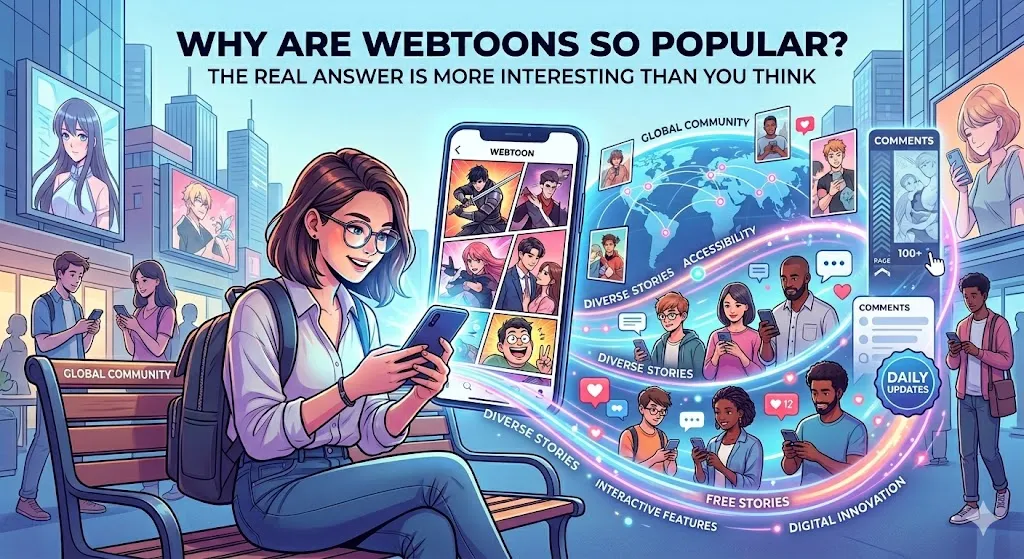
There is an important distinction between content that is mobile-accessible and content that is mobile-native. Traditional comics digitized for tablets are mobile-accessible — you can read them on a phone, but the experience was designed for print and has simply been ported. Webtoons are mobile-native: the vertical strip format, the color choices optimized for backlit screens, the panel sizing calibrated to thumb-scroll rhythm, the episode lengths tuned to a commute or a lunch break — all of these decisions were made with a phone screen as the assumed context, not an afterthought.
Over 72% of webtoon users access content via smartphones, drawn to the vertical scroll and binge-friendly structure. That number reflects design intention as much as user preference. When a format is engineered around the device and the behavior, adoption follows naturally.
The timing of webtoons’ global expansion also mattered enormously. The format originated in South Korea in the early 2000s, precisely as smartphone adoption was beginning to accelerate globally. By the time LINE Webtoon launched internationally in 2014, smartphone penetration in key markets had reached the critical threshold where mobile-native content could find mass audiences. Global smartphone users surpassed 7.1 billion in 2025 — nearly the entire planet is now carrying the device webtoons were designed for.
The Episode Model Creates a Specific Kind of Addiction
Weekly releases and cliffhangers — engineered anticipation
Webtoons are episodic by structure: most series release one episode per week, each episode ending in a way that makes the next one feel necessary. This is not accidental. The weekly release cycle is a deliberate engagement mechanic that borrows from television serialization — the same mechanism that made people show up every Thursday night for a network drama is what brings webtoon readers back every Wednesday for the next chapter of a story they are invested in.
The difference between webtoons and binge-watchable streaming content is instructive. Netflix’s model encourages full-season consumption in a weekend and then a long wait for the next season — intense engagement followed by a long gap. Webtoon’s weekly episode model produces continuous low-level engagement: a habit rather than an event. Readers who follow 10 series have something to read every day of the week. The platform becomes part of a daily routine in the same way that checking social media does — except that at the end of the habit loop, there is a story payoff rather than a scroll through content.
The “fast pass” or “early access” premium model that major platforms use amplifies this mechanic cleverly. Readers who cannot wait for free weekly episodes can pay a small fee to unlock the next several chapters immediately. The episode model creates the desire; the fast pass monetizes the impatience. It is a payment model that only works because the episodic format has already made waiting feel genuinely uncomfortable.
📊 Engagement Mechanic
The “Just One More Chapter” Effect
Research from the University of Southern California found that 47% of webtoon users consider the medium “more relatable” than traditional comics due to its digital-first storytelling style. The episodic format contributes to this — readers don’t just consume a story, they live with it across weeks and months, which creates emotional investment that a single-sitting read cannot build. Characters become companions rather than subjects of a story.
The Creator Economy Made Webtoons Unstoppably Diverse
No gatekeepers. Any story. Any creator. Global audience.
Traditional print comics require publishing deals. Publishers require commercial viability. Commercial viability requires stories that publishing executives believe will sell to a market they understand. The result, historically, was an industry dominated by a narrow range of story types, art styles, and creator demographics — predominantly Western, predominantly male, predominantly superhero or action-oriented.
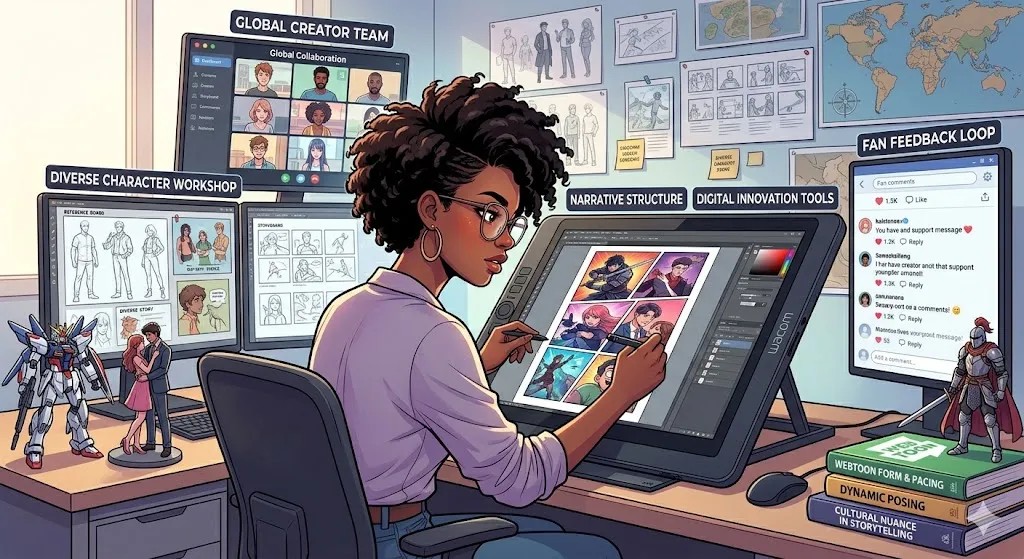
Webtoon platforms eliminated this gatekeeping entirely. Unlike traditional manga or Western comics, which often require a gatekeeper or a major publishing house, webtoons allow independent artists to reach a global audience directly. This has led to a more diverse range of stories, reflecting a variety of cultural backgrounds, gender identities, and social issues that were previously underrepresented in mainstream media.
The scale of this democratization is striking. Naver Webtoon had over 120,000 active series in 2023, with 3,500 new series uploaded monthly — an average of 116 per day. No traditional publisher could evaluate, commission, and produce content at anything approaching that rate. The platform model outsources curation to readers — popular series rise, niche series find their niche, and everything finds someone.
👩🎨 Creator Demographics
Who Is Making Webtoons
Lezhin Comics reported that 63% of its creators are under 30, with 51% self-identifying as female. This demographic profile of the creator base directly explains the demographic profile of the reader base — stories written by young women for audiences that include young women produce content that those audiences find more relevant and engaging than content produced by a different demographic for a different assumed audience. The creator diversity is structural, not incidental.
The revenue model for creators has also matured significantly. Creator-led platforms including Webtoon and Tapas offer ad revenue sharing, crowdfunding, and global distribution that empower independent artists and encourage content diversity. For creators in Southeast Asia and Latin America in particular, webtoon platforms have become primary sources of income — the creator economy dimension of the webtoon market intersects with broader freelance digital work trends in ways that traditional publishing never enabled.
⚡ AI and the Creator Economy in 2026
What AI Is Doing to Webtoon Production
A 2023 survey by the Webtoon Creators Guild found that 78% of creators use AI tools for scriptwriting or art, though 64% prefer human-generated content for dialogue. As of early 2026, platforms are deploying AI-assisted coloring tools, background generation engines, and panel layout assistants that allow individual creators to maintain weekly publishing schedules previously achievable only by teams. This AI-augmented production capability is expected to drive a 35–45% increase in new series volume on major platforms between 2025 and 2027 — which means the content library is about to get dramatically larger, even faster.
They Found the Audience Traditional Comics Ignored
The readers traditional comics never tried to reach
Traditional Western comics — particularly the superhero genre that dominated the American market for decades — built their audience around a specific demographic: young to middle-aged men who visit comic book shops on release day. The industry’s own data referred to this core audience as “Wednesday Warriors.” The stories, art styles, and marketing were calibrated for this group. Everyone else was an afterthought.
Digital platforms found a massive, untapped audience by successfully tapping into an audience the industry had long overlooked: Gen Z and Millennial women. In 2023, 58% of global webtoon users are female, 38% are male, and 4% are non-binary or other. This gender breakdown is almost the exact inverse of the traditional print comics reader demographic. It did not happen accidentally — it happened because the creator demographics (predominantly young, female, diverse) produced content that this previously underserved audience actually wanted to read.
The age profile of webtoon readers is equally significant. Over 50% of webtoon readers are aged between 18 and 34. This is the demographic that grew up with smartphones as their primary media device, that discovered stories through social platforms rather than physical shops, and that has no particular attachment to print formats as the “correct” way to consume visual storytelling. For this audience, webtoons are not a new kind of comic — they are simply what comics are.
“58% of global webtoon users are female. The industry that ignored them for decades has discovered that serving them well produces one of the fastest-growing entertainment markets in the world.” — Audience analysis
The Korean Wave Arrived First, and Webtoons Rode It
K-pop, K-drama, and then K-comics — in that order
Webtoons did not become globally popular in isolation. They rode the crest of the Hallyu wave — the global cultural expansion of Korean popular culture — which had already spent a decade building international infrastructure for Korean content distribution before webtoons went mainstream globally.
The sequence matters. K-pop built global audiences for Korean cultural products through music — these audiences were already engaged with Korean culture, subscribed to Korean entertainment platforms, and receptive to Korean storytelling. K-drama followed, amplified enormously by Netflix’s investment in Korean content — Squid Game, All of Us Are Dead, Sweet Home, Extraordinary Attorney Woo. And then the audiences for those dramas discovered that many of them were based on webtoons — and went to find the source material.
Over 40 popular K-dramas in the last three years were based on webtoon IPs, with titles like All of Us Are Dead and Sweet Home crossing over into global streaming platforms. In 2025, over 40% of new Korean dramas were based on webtoon properties. This bidirectional pipeline — webtoons generating IP that becomes dramas, dramas generating audiences who become webtoon readers — is one of the most effective audience-building flywheels in contemporary entertainment.
The Genre Range Is Unlike Anything in Print Comics
One of the most practically important reasons webtoons have found such large audiences is the breadth of what they cover. Traditional print comics were genre-narrow by commercial necessity — publishers needed to sell enough copies to justify print runs, which required targeting the largest available audience with the most commercially proven genres. The result was a market dominated by superhero action for decades, with romance, slice-of-life, horror, and literary fiction occupying marginal positions.
Webtoon platforms have no print run to justify. A romance series with 50,000 loyal readers is economically viable in a way it never could be in print. A horror series with a passionate niche following sustains itself on fast-pass purchases and merchandise. A slice-of-life series about mundane daily life attracts readers who have never engaged with any comic before and discovers an entirely new audience category.
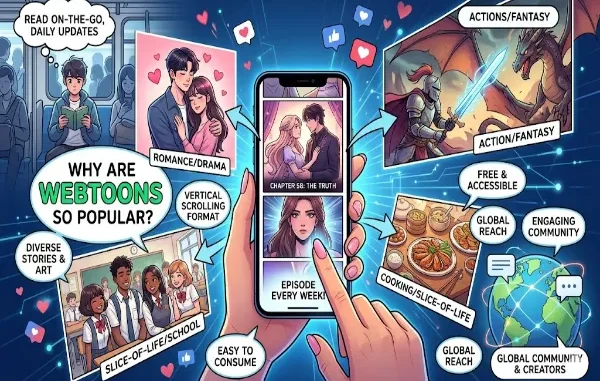
The genre distribution of the webtoon market in 2026:
In 2024, romance and fantasy webtoons were the most popular, accounting for over 50% of the market share. But the long tail of niche genres is what keeps readers on the platform — every reader who arrives for romance eventually discovers horror, or vice versa. The recommendation algorithm serves as a genre bridge, and the sheer volume of content (120,000+ active series on Naver alone) means that almost any specific taste has a webtoon that serves it.
🏳️🌈 Inclusivity as Strategy
LGBTQ+ Content Drove Significant Growth
Titles such as the yuri webtoon Not So Shoujo Love Story, which has garnered over 73 million views, underscore the rising demand for inclusive, genre-specific narratives. Webtoon platforms made a deliberate strategic decision to serve LGBTQ+ readers who had been almost entirely ignored by traditional comics publishers. The result was not just moral correctness — it was a significant new reader base with strong engagement metrics and high willingness to pay for premium content.
The Free Model Removed Every Barrier to Entry
The economics of traditional comics created multiple friction points between potential readers and content. Physical copies cost money and required travel to a shop. Digital comics required purchases per issue. Subscriptions required commitment before a reader knew whether they liked the content. For someone who had never read a comic before, the barrier to discovering whether they would enjoy the medium was substantial.
Webtoon’s free model eliminates all of this. A reader can discover, begin, and read dozens of chapters of any series without spending a cent or providing a credit card. The commitment required to try something new is nothing — a few minutes and a tap. This is how webtoons converted people who had never considered reading comics into daily active users: the cost of discovering a good story was zero.
The monetization model — fast pass for impatient readers, premium coins for unlocking older episodes, merchandise, and in the creator’s case, ad revenue sharing — converts engaged readers into paying customers after they are already emotionally invested. This sequencing is critical. You fall in love with the story first. Then you pay to read it faster. No traditional publishing model works this way, and its effectiveness shows in the user numbers.
💡 Monetization Insight
Free Entry, Paid Impatience
The webtoon monetization model is a masterclass in delayed payment. Readers who would never pay $4.99 for a comic they haven’t read will absolutely pay $0.99 to read a chapter three days early after they’re already emotionally invested in a cliffhanger. The platform doesn’t ask readers to pay for access — it asks them to pay for the relief of not having to wait. That’s a fundamentally different value proposition, and it works.
Webtoons Built Genuine Communities Around Stories
Reading a physical comic is a solitary experience. You buy the issue, you read it, perhaps you discuss it at a shop on Wednesday. Reading a webtoon is a social experience by design — every episode has a comment section, and those comment sections are active, real-time, and visible to the creator.
The comment section bridges the gap between creator and consumer, allowing for a real-time cultural dialogue that shapes the story as it evolves. Creators read comments. Readers know creators read comments. This creates a feedback loop that traditional publishing cannot replicate — the audience participates in the story’s development in a way that goes beyond passive consumption. When a beloved character is in danger, readers flood the comment section with emotional reactions that the creator sees. This is not just engagement — it is genuine co-creation of the emotional experience of the story.
Beyond the native comment sections, webtoon communities have built substantial ecosystems on external platforms. TikTok, Reddit, Twitter, and Discord host webtoon fan communities that generate organic discovery for new series. A single viral TikTok video highlighting a webtoon’s emotional story beat can generate millions of new readers within days. Teen readers in particular are exceptionally valuable organic marketing channels — their high social media activity means their enthusiasm spreads rapidly and authentically in ways that paid advertising cannot replicate.
The Psychology of Vertical Scrolling and Flow States
There is a neurological dimension to webtoon engagement that rarely gets discussed in popularity analyses. The design of webtoons — high-contrast colors, rhythmic panel pacing, the physical act of continuous vertical scrolling — is particularly effective at inducing what psychologists call a “flow state”: a condition of deep, effortless immersion in a task where time perception changes and engagement becomes self-sustaining.
The high-contrast colors and specific panel arrangements in webtoons are designed to keep the brain engaged, often leading to what psychologists call a “flow state.” This state of deep immersion is what makes the medium so addictive. The continuous scroll — unlike the page-turn of a book or the click-to-advance of a slideshow — provides a sense of frictionless motion that mimics the experience of watching a film while maintaining the interactivity of reading. The brain processes the experience as ongoing rather than episodic, which reduces the moments where a reader might decide to stop.
This is also why webtoon readers so frequently report reading “more than intended” — the format is optimized to minimize natural stopping points and maximize continuation. The episode structure creates formal endpoints, but within an episode the vertical scroll creates a continuous experience that resists interruption. Platforms are aware of this dynamic and design it intentionally.
🧠 Reader Psychology
Why “Just One More Chapter” Works Differently in Webtoons
The digital comics format, and webtoons specifically, use color, pacing, and scroll rhythm to create reading experiences that are genuinely harder to stop than print comics. The absence of page turns removes a natural decision point. The cliffhanger-at-episode-end creates a cognitive gap that the brain seeks to close. The available-next-episode removes the friction of acquisition. Each of these design decisions is individually small; together they produce the “just one more chapter” phenomenon that webtoon readers describe constantly and that drives the platform engagement metrics that make investors excited about the market.
TV and Film Adaptations Created a Loop of New Readers
One of the most powerful recent drivers of webtoon popularity is entirely external to the format itself: the aggressive adaptation of webtoon IP into television dramas, animated series, and films. By 2025, over 30 webtoon-to-screen adaptations were in active production or had recently released globally, validating the format’s power as a creative IP incubator.
The adaptation pipeline works as a reader acquisition engine. Someone who watches a K-drama on Netflix and enjoys it searches for the source material. They find the webtoon. They begin reading. They become a webtoon reader — not because they sought out comics, but because a story they loved on television led them to the place where that story lived first. This conversion path is repeatable, scalable, and increasingly well-understood by platforms that are now actively developing webtoon IP with adaptation in mind from the beginning.
| Webtoon / Manhwa | Adaptation | Platform | Global Reach |
|---|---|---|---|
| All of Us Are Dead | Netflix Drama (2022) | Netflix Global | Top 10 Globally |
| Sweet Home | Netflix Drama (2020) | Netflix Global | Top 10 Globally |
| Solo Leveling | Anime Series (2024–25) | Crunchyroll | Global Phenomenon |
| True Beauty | K-Drama (2020) | tvN / Viki | Major Asian Hit |
| Itaewon Class | K-Drama (2020) | JTBC / Netflix | International Hit |
| Yumi’s Cells | Drama + Animated Film | tvN / Streaming | Regional Success |
The 2026 boom in manhwa-to-anime adaptations is being driven by a potent mix of Japanese–South Korean co-productions and aggressive streaming platform acquisitions, solidifying a pipeline of over 20 new series. Crunchyroll, TVING, and Aniplus have all secured key titles for regional and global distribution. The result is a more interconnected entertainment market where webtoons and their adaptations continuously feed each other’s audiences — each new drama or anime series is both a product and a marketing campaign for the source material.
What Happens Next: Sound, AI, and Interactive Stories
The reasons webtoons have become popular so far are all essentially about format, access, community, and cultural timing. The reasons they may become even more popular over the next decade involve technological evolution that goes significantly beyond anything the format currently offers.
Sound and Animation
68% of platforms now add sound effects, animations, or AR to digital comics. The integration of audio — ambient sound, music, voice acting — into webtoon reading experiences transforms the medium from a visual-only format toward something closer to an interactive film. Several major platforms have already deployed “webtoon dramas” that incorporate short video segments within comic episodes. The line between webtoon and animated series is beginning to blur, and the direction of blur is toward more immersive, more sensory-rich experiences that deepen engagement further.
Interactive Storytelling
Interactive storytelling innovations such as multimedia enhancements, sound effects, and reader-driven plot choices are reshaping user engagement. LINE Webtoon reported that 40% of its series are “participatory,” allowing user choices that alter plot outcomes. When readers can influence the story they are reading, the engagement relationship changes fundamentally — they are no longer audience members but participants. The emotional investment of participation exceeds the emotional investment of passive consumption, which produces the loyalty and monetization behavior that platforms and creators need.
AI-Assisted Creation
The combination of AI-assisted creation tools and the webtoon format’s native suitability for individual creators is expected to produce a significant expansion of content volume through 2027. AI-augmented production capability is expected to drive a 35–45% increase in new series volume on major platforms between 2025 and 2027, significantly expanding content libraries and reducing subscriber churn by ensuring fresh reading options. More series means more chances to find the specific story that converts a curious visitor into a committed daily reader — the content library benefit compounds with time.
🔮 Looking Forward
The Market in 2035
The webtoon market was valued at $7.8 billion in 2025. Conservative forecasts project $28 billion by 2034 at a 15.5% CAGR. More aggressive projections based on higher growth assumptions put the market at $36–140 billion by 2035. The range of projections reflects genuine uncertainty about the pace of global expansion, AI-driven content growth, and the degree to which webtoons successfully penetrate markets like India, Southeast Asia, Latin America, and Africa — all of which have the smartphone infrastructure webtoons need but have not yet reached full webtoon market saturation.
The Real Answer, In One Place
Webtoons are popular because of a specific convergence that was not planned by any single company and could not have been manufactured by marketing alone. The format was designed for a device that the entire world subsequently adopted. The creator demographics produced stories for an audience that the existing industry was completely ignoring. The episodic free model removed every barrier to entry while creating powerful engagement mechanisms. The Korean cultural wave built the global infrastructure for distribution. The adaptation pipeline created a self-reinforcing loop of new readers. And the psychological properties of vertical scrolling make the medium genuinely, measurably harder to put down than its print predecessors.
None of these factors alone explains the $7.8 billion market or the 82 million monthly active users. All of them together do — and understanding which factor matters most for a given reader helps explain both who reads webtoons and why they keep reading them.
The format succeeded not because it was technologically innovative but because it understood something about the audiences it was serving that incumbent industries had missed or ignored. That is almost always the real story behind any medium’s rise — not the technology, but the people it was finally made for.
The Bottom Line
Webtoons are popular because they were made for the right people, at the right time, on the right device — and then they got out of the way and let those people tell the stories.
A $7.8B market growing at 15–30% annually. 82 million monthly readers. 58% female. 72% on smartphones. Over 40 K-drama adaptations in three years. The numbers describe not a trend but a structural shift in how visual stories are created and consumed — one that is still accelerating.
Leave a Reply