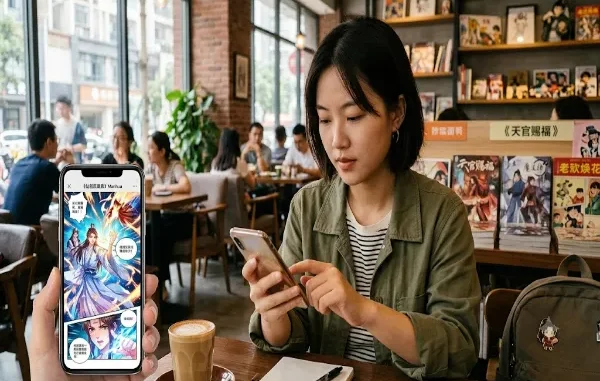
If you have spent any time browsing webcomic apps over the past several years, you have probably scrolled past titles with sweeping fantasy art, cultivators wielding glowing swords, or modern romance stories drawn in vivid color, all under the tag “manhua.” For readers who grew up on Japanese manga or Korean manhwa, manhua can feel like a familiar cousin, similar in some ways but distinct in others once you start paying attention.
Here is a full breakdown of what manhua actually is, where it came from, how it differs from manga and manhwa, and why it has become one of the fastest-growing corners of the global comics world.
What Manhua Actually Means
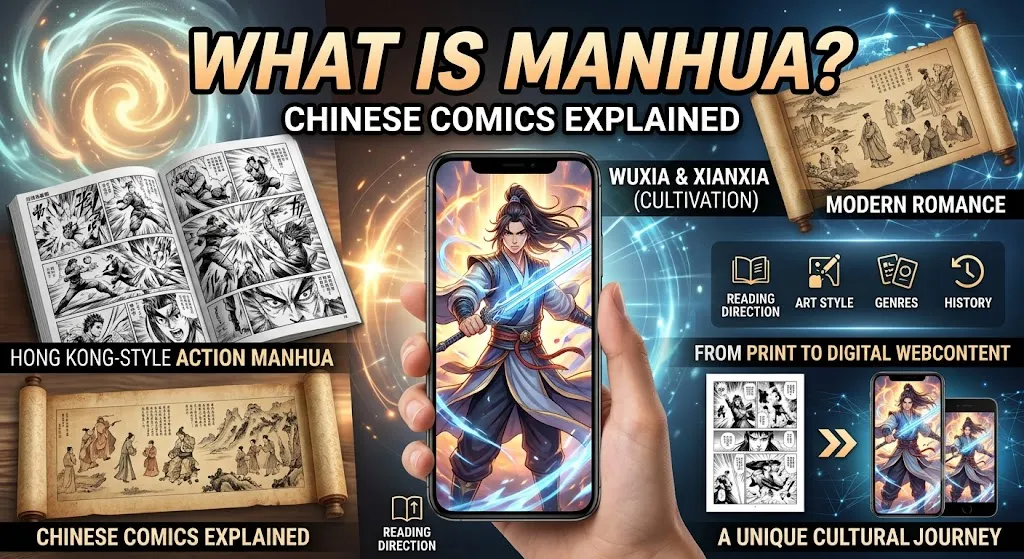
Manhua is the general term for Chinese comics, encompassing work from mainland China, Hong Kong, and Taiwan. The word itself is built from two characters meaning roughly “random” or “freeform” and “drawing,” a linguistic root it actually shares with the Japanese word manga and the Korean word manhwa, since all three terms trace back to the same Chinese characters, adapted into each country’s own language and reading.
Despite the shared linguistic origin, manhua has developed its own distinct visual style, storytelling conventions, and industry structure over the decades, shaped by China’s own cultural history, censorship environment, and, more recently, the explosive growth of mobile-first digital comics platforms.
A Quick History
Chinese comic art has roots stretching back much further than most casual readers realize, with narrative illustrated storytelling appearing in various forms for centuries. The more direct ancestor of modern manhua is often traced to a format called lianhuanhua, meaning “linked pictures,” which became popular in the early twentieth century. These were small, inexpensive picture books that told stories through sequential illustrations paired with brief text, often adapting folk tales, historical stories, and later political and social themes, and they were widely read across China for much of the twentieth century.
Modern manhua as most readers recognize it today began taking shape more distinctly in the latter half of the twentieth century, particularly in Hong Kong, where action and martial arts comics became especially popular, developing a bold, dynamic art style often compared to the intensity of American action comics. Taiwan also developed its own strong manhua tradition, with a somewhat different tone and subject matter that leaned more toward fantasy and romance in various periods.
The industry shifted dramatically again with the rise of mobile internet and smartphone reading in mainland China during the 2010s, which opened the door for a new generation of digital-first manhua, often serialized in full color and optimized for vertical scrolling on a phone screen rather than traditional printed panels read page by page.
Manhua vs. Manga vs. Manhwa
These three terms get used interchangeably by casual readers sometimes, but there are real, consistent differences worth understanding.
Manga, the Japanese term, is traditionally published in black and white, read right to left in its original format, and organized in a fairly standardized panel-based page layout, typically serialized first in weekly or monthly print magazines before being collected into paperback volumes.
Manhwa, the Korean term, has become closely associated with the vertical-scroll webtoon format that exploded in popularity through platforms built specifically for mobile reading. Manhwa is typically produced in full color, designed to be scrolled through vertically on a phone rather than read page by page, and often released as individual chapters on a regular schedule rather than through print volumes first.
Manhua sits in an interesting middle position. Traditional, older manhua, particularly from Hong Kong’s action comic tradition, shares more visual DNA with manga, sometimes in black and white and organized in more traditional panel layouts. Modern digital manhua, on the other hand, particularly the kind popular on mobile apps over the last decade, has moved heavily toward the same full-color, vertical-scroll format that defines contemporary manhwa, making the two genuinely difficult to distinguish visually at a glance unless you already know the title’s country of origin.
Reading direction also varies more in manhua than in manga, since it is not bound by the strict right-to-left convention that manga maintains even in translated editions. Digital manhua, especially newer webcomic-style releases, is generally read top to bottom, scrolling continuously, similar to manhwa.
Common Genres and Storytelling Themes
Manhua draws on some genre traditions that are distinctly rooted in Chinese literary and cultural history, alongside genres shared broadly across East Asian comics.
Wuxia, a genre centered on martial artists, swordsmen, and codes of honor set against historical or quasi-historical Chinese backdrops, has deep roots in Chinese literature and remains a foundational influence on manhua storytelling, even in series that are not strictly wuxia themselves.
Xianxia and cultivation stories represent one of the most distinctly Chinese contributions to global fantasy fiction, and manhua adaptations of cultivation novels have become hugely popular both domestically and internationally. These stories typically follow characters progressing through ranked stages of spiritual or martial power, often drawing on concepts loosely inspired by Daoist and Buddhist cosmology, immortality, and elemental energy systems, reimagined through a fantasy lens.
Beyond these more distinctly Chinese genres, manhua also covers plenty of familiar ground shared across the broader webcomic world: modern romance, school life drama, isekai-style stories where a character is transported into another world or body, urban fantasy, and action-adventure series featuring original power systems and world-building.
The Digital Boom
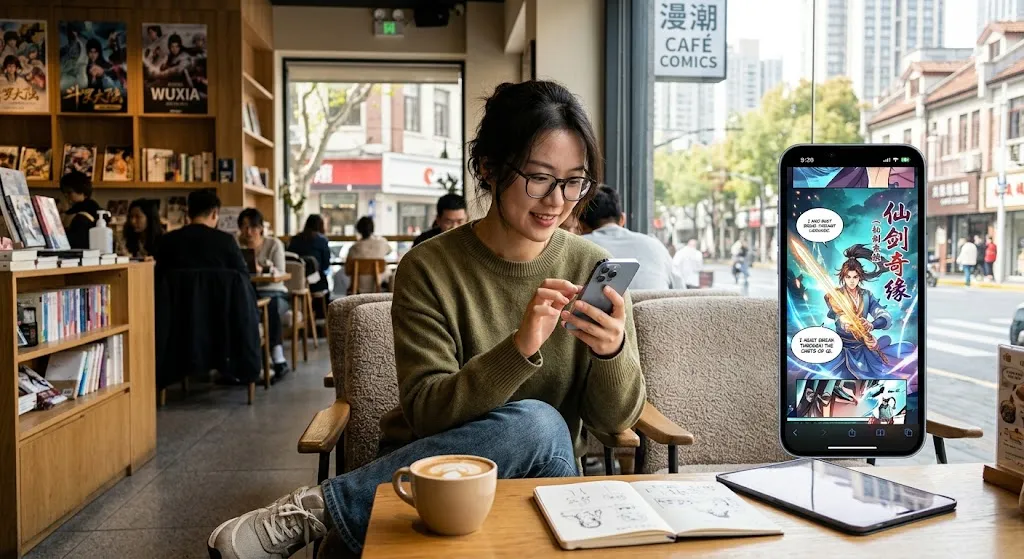
The biggest shift in manhua over the past decade has been the move from print to mobile-first digital publishing, largely mirroring what happened with Korean manhwa around the same period. Platforms built specifically for smartphone reading, offering full-color art, vertical scrolling, and regular chapter releases, have become the primary way most new manhua reaches its audience, both domestically in China and increasingly for international readers through translated releases.
This shift has also fueled the growth of donghua, meaning Chinese animation, since many successful manhua and the web novels they are based on have gone on to receive full animated adaptations, following a pipeline that closely mirrors how popular manga in Japan often gets adapted into anime. Several cultivation and fantasy manhua franchises have become genuinely major media properties in China through this novel-to-manhua-to-donghua pipeline, generating enormous audiences across all three formats.
Where to Read Manhua
Several platforms now offer official, licensed manhua translated for English-speaking and other international audiences, alongside the original Chinese-language platforms serving the domestic market. Apps built around webcomic-style reading, including some run directly by major Chinese platforms and others that license and translate content for global distribution, have made it far easier than it used to be to find and support manhua legally, rather than relying on unofficial scanlation sites, which remain widespread but do not compensate the original creators.
For readers new to the format, browsing by genre tags like cultivation, wuxia, or romance on a legitimate webcomic platform tends to be the easiest way to get a feel for the range of tone and art style within manhua before committing to a longer series.
A Few Well-Known Examples
Certain manhua have crossed over into genuinely wide international recognition, often through their accompanying donghua adaptations. Titles built around cultivation and power-progression storytelling, along with a strong wave of wuxia-adjacent fantasy series, have found substantial overseas fanbases over the past several years, introduced to many international readers first through streaming anime platforms that picked up the animated adaptations, and later explored further through the original manhua and source novels. This pipeline, where a novel becomes a manhua and then a donghua, has become one of the more distinctive patterns in how Chinese pop culture properties build an audience both domestically and abroad.
Why Manhua Has Grown So Much Internationally
A few factors have converged to push manhua onto a much bigger global stage than it occupied even a decade ago. The rise of mobile-first, full-color webcomic reading lowered the barrier to entry for casual readers used to that format from manhwa. Official translation efforts by major platforms have made it easier to access manhua legally in languages beyond Chinese. And genuinely distinct genre contributions, particularly xianxia and cultivation storytelling, have offered international readers something that feels fresh compared to more familiar manga and manhwa tropes, even while sharing some structural similarities with both.
China’s broader entertainment industry has also invested heavily in adapting popular web novels and manhua into higher-budget donghua and, in some cases, live-action adaptations, further raising the profile of the source material and drawing new readers back to the original comics.
The Bottom Line
Manhua is not simply “Chinese manga” in the way casual descriptions sometimes suggest. It carries its own historical lineage stretching back to early twentieth-century illustrated storytelling, its own distinct genre contributions rooted in Chinese literary tradition, and, in its modern digital form, a visual style that has evolved alongside the broader webcomic boom shared with Korean manhwa. Whether you come to it through a cultivation fantasy epic, a wuxia adventure, or a full-color modern romance, manhua represents a genuinely distinct and increasingly influential branch of the global comics landscape, worth exploring on its own terms rather than as a simple stand-in for manga or manhwa.
Leave a Reply