
If you’ve watched Korean television at all over the past few years, you’ve probably noticed a pattern without necessarily naming it. A show has that particular rhythm — the paneled, almost frame-by-frame pacing, the exaggerated close-ups, the plot twist that lands exactly where a chapter would have ended on a cliffhanger. Then you look it up, and sure enough: it started life as a webtoon.
This isn’t a coincidence or a passing trend. Manhwa-to-drama adaptations have become one of the dominant creative and business strategies in Korean entertainment, and 2026 in particular has been described as a turning point where the format shifted from experimental side project to primary engine of production. So what’s actually driving this, and why now?
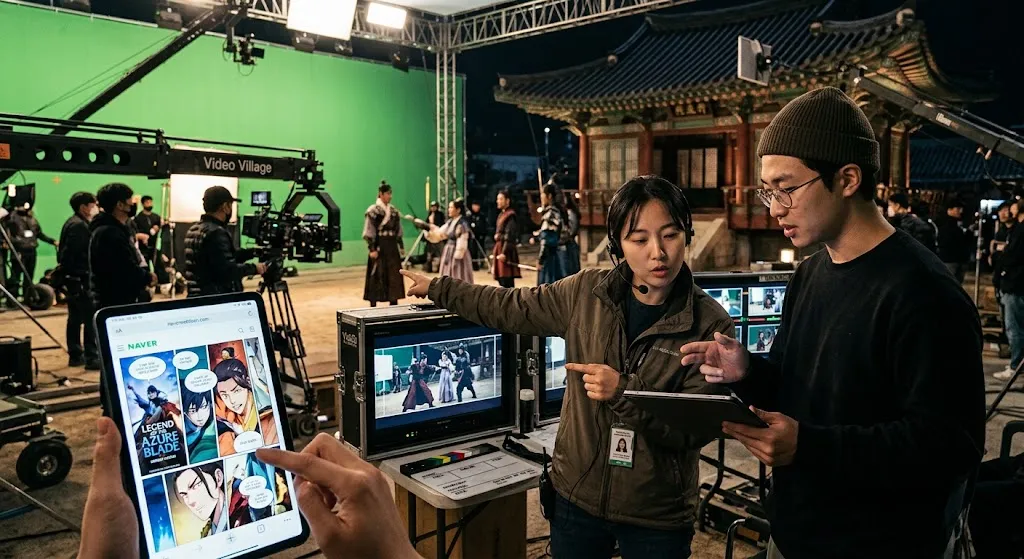
Wait, What Exactly Is Manhwa?
Quick definitional pit stop, since the terms get used loosely. Manhwa is the general term for Korean comics, but in the context of this conversation, people almost always mean webtoons specifically — the vertically scrolling, full-color digital comics native to platforms like Naver Webtoon and Kakao Webtoon (formerly Kakao Page), designed to be read on a phone with your thumb rather than flipped through on paper.
That distinction matters more than it seems, because the format itself — long-form, serialized, cliffhanger-driven, released chapter by chapter to a live audience — turns out to be almost perfectly shaped for adaptation into episodic television.
The Built-In Fanbase Is the Whole Point
The single biggest reason studios keep reaching for webtoons is the least mysterious one: risk reduction. A story that’s already been read by millions of people, argued about online, and kept a platform’s top charts occupied for months isn’t a gamble anymore — it’s closer to a market-tested product.
The scale involved here is genuinely enormous. The upcoming drama adaptation of The Remarried Empress is based on a webtoon and novel that has racked up a staggering 2.7 billion views, and it’s headlining a slate where Disney+ and Netflix are now locking down exclusive rights to what’s described as “billion-view intellectual property.” When a story arrives with an audience that size already built in, a studio isn’t just buying a plot — it’s buying a marketing campaign, a built-in premiere-night audience, and a level of pre-existing emotional investment that an original script simply can’t manufacture from scratch.
This same logic has already reshaped the anime industry in a way that’s instructive for dramas too. Solo Leveling’s anime adaptation didn’t just perform well — it became the first manhwa-based anime to win Crunchyroll’s Anime of the Year award, and the ripple effect was so significant that LINE Webtoon’s own CEO publicly pledged at least 20 new anime adaptations based on webtoons, a commitment that’s carried straight through into the 2026 release calendar. Live-action drama studios have been watching the same numbers.
The Format Practically Storyboards Itself
There’s a production-side reason this works so well, too, and it’s easy to underestimate: webtoons are already visual media. Unlike adapting a novel, where a director has to invent blocking, pacing, and imagery from prose description, a webtoon arrives with panel composition, character designs, color palettes, and emotional beats already worked out by an artist. In a very real sense, someone has already storyboarded large portions of the show.
This shows up on screen in ways longtime webtoon readers notice immediately — the freeze-frame reaction shots, the way a single dramatic reveal gets its own extended, lingering shot the way a splash panel would in the source material. It’s not accidental. It’s a format translating fairly directly from one visual medium to another, which is a much shorter creative distance than going from text to screen.
It also solves a practical development problem: the story’s central hook, tone, and structure have already been pressure-tested through however many chapters and reader comments the original ran for. Weak arcs get identified by the fandom in real time, popular arcs get identified the same way, and by the time a studio option is signed, there’s a fairly detailed map of what audiences responded to and what they didn’t.
The Genre Range Has Exploded
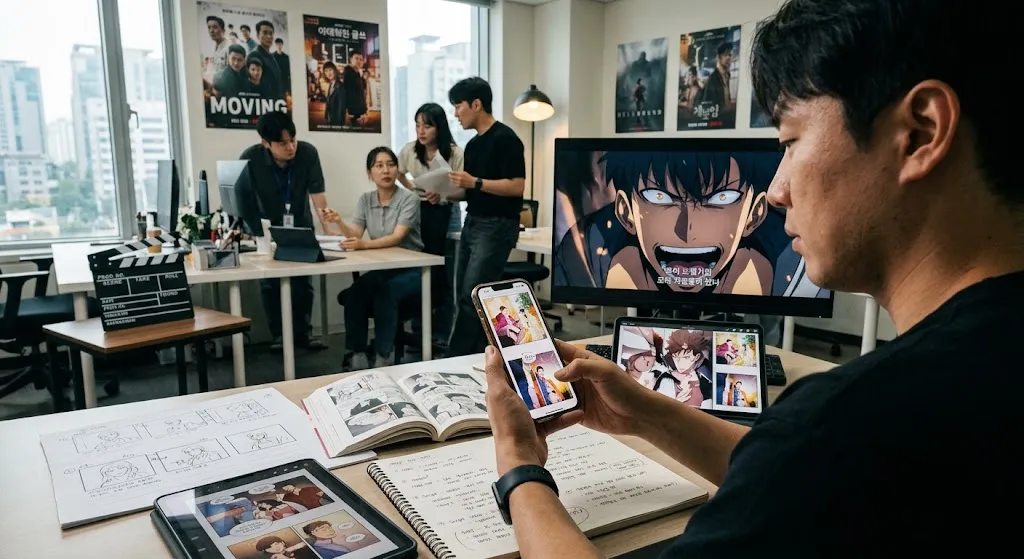
Early on, webtoon adaptations leaned heavily on a few reliable lanes — high school romance, workplace rom-coms, the occasional supernatural twist. That’s expanded dramatically. The 2026 slate alone spans, on one side, big-budget historical fantasy romance, and on the other, gritty action-thriller territory, with platforms explicitly splitting along those lines — one going after glossy romantic fantasy epics, the other doubling down on violent, adrenaline-driven thrillers.
That range matters because it means webtoon adaptation isn’t a genre choice anymore, in the way “based on a webtoon” briefly implied a specific kind of show. It’s become a source strategy that cuts across nearly every genre Korean television makes, from horror to corporate drama to crime thrillers to sweeping period romance — which is exactly what you’d expect from a source medium as large and varied as Korean webtoon publishing has become.
It’s a Global Streaming Strategy, Not Just a Local One
The other major force behind this trend is where these shows actually end up living: global streaming platforms, competing directly for exclusive rights to the biggest titles. This isn’t incidental — it’s become a defining feature of the market, with major platforms treating billion-view webtoon IP as prestige acquisition targets the same way a studio might bid on a bestselling novel’s film rights.
There’s a clear commercial logic here beyond simple fandom size. A webtoon with hundreds of millions of views already has proof of international appeal — Naver and Kakao’s platforms reach readers far beyond Korea, meaning a hit webtoon typically arrives with global name recognition already built in, in a way an original Korean-language script usually doesn’t. For a streaming platform trying to justify a big production budget with confidence that a global audience will actually watch, that’s an unusually reassuring data point to have in hand before a single scene is filmed.
It’s Not Without Friction
None of this is to say the format guarantees success, or that adaptation is a purely mechanical, risk-free process. Longtime readers of a webtoon often arrive at the drama with very specific expectations, and studios don’t always meet them. One recent adaptation drew notice for changes to its source material that some fans found genuinely controversial, even as the show itself went on to top international rankings — a reminder that a built-in audience is a double-edged advantage: it guarantees attention, but it doesn’t guarantee approval.
There’s also a structural tension worth naming: webtoons are frequently long-running, sprawling stories built for indefinite serialization, while a drama typically needs to resolve, or at least meaningfully pause, within 12 to 16 episodes. Compressing hundreds of chapters into a season inevitably means cutting subplots, merging characters, or changing pacing in ways that can frustrate readers who came in already knowing — and loving — the slower version.
Why This Isn’t Slowing Down
Put all of this together and the appeal to studios becomes fairly straightforward. Webtoon adaptation offers a built-in audience, a pre-validated story, a head start on visual direction, genre flexibility across virtually every kind of show a network wants to make, and a credible case for global appeal that helps justify the budgets modern prestige dramas require. That’s an unusually complete set of advantages for any one sourcing strategy to offer, which is exactly why it’s gone from niche experiment to what one industry breakdown flatly called the primary engine for Korean drama production in 2026.
For viewers, the practical upshot is simple: if you’ve enjoyed a Korean drama recently and found yourself wondering why it felt so visually distinct, so confidently paced, or so oddly cliffhanger-heavy at the end of nearly every episode — there’s a decent chance the answer is sitting a few scrolls away on a webtoon app, chapters ahead of whatever you just watched.
Frequently Asked Questions
Manhwa is simply the general term for Korean comics, the way “manga” refers to Japanese comics. In practice, most manhwa discussed today are webtoons specifically — full-color comics formatted for vertical scrolling on a phone, published on platforms like Naver Webtoon and Kakao Webtoon rather than in print.
It’s related but distinct. Korean webtoons are being adapted into both anime (mostly by Japanese studios, distributed through platforms like Crunchyroll) and live-action Korean dramas (by Korean networks and global streamers like Netflix and Disney+). Solo Leveling is the clearest example of the anime side of this wave; The Remarried Empress and Business Proposal represent the drama side.
Because much of the visual groundwork — panel composition, character design, color palette, dramatic framing — was already established by the original artist. Directors are translating an already-visual medium rather than building imagery from scratch, which is part of why these shows often have a distinctive, almost freeze-frame visual rhythm.
It varies. Built-in fandoms guarantee attention, but not automatic approval — changes made to fit a shorter episode count or a different tone have drawn criticism in some adaptations, even when the resulting show performs well commercially.
It’s expanded well beyond romance. Recent and upcoming slates span historical fantasy, horror, workplace drama, crime thrillers, and gritty action — streaming platforms have increasingly split by tone, with some favoring high-budget fantasy/romance and others favoring darker action-driven material.
Webtoons with hundreds of millions or billions of views already have proof of a large, often international readership before a single scene is filmed. For platforms funding expensive prestige productions, that existing audience data is a meaningfully reassuring signal compared to greenlighting an original script with no comparable track record.
Sources & Further Reading
- Outlook Respawn — 2026 Webtoon K-Dramas: Why This Is the Biggest Year for the Genre: coverage of the Netflix/Disney+ competition for webtoon IP and major 2026 titles
https://respawn.outlookindia.com/pop-culture/pop-culture-news/2026-webtoon-k-dramas-why-this-is-the-biggest-year-for-the-genre - Outlook Respawn — Every Manhwa Getting an Anime Adaptation in 2026: background on Solo Leveling’s industry impact and the wider manhwa-to-screen pipeline
https://respawn.outlookindia.com/pop-culture/pop-culture-originals/every-manhwa-getting-an-anime-adaptation-in-2026 - Indiana Anime Network — Rise of Manhwa in Anime (2025 Update): How Webtoons Are Dominating the Screen: details on Naver Webtoon and Kakao Webtoon’s platform scale and adaptation strategy
https://indiananimenetwork.com/?p=7348
Leave a Reply